How to Get Technology Befitting of Your Luxury Home
A Guide to Consistent High-End Performance for Years to Come
There’s a common misconception that what makes a home smart are the devices you install. But they’re just the end point of a well-orchestrated hidden technology infrastructure. Think of it similarly to your home’s plumbing system.
Your sinks, faucets, and toilets need to be top-caliber: effective, reliable, and in line with your home's décor. But what really matters is behind the scenes. You need sturdy pipes in the right places, all being fed by a water line, managed by a pressure regulator, with water heaters to get comfortable temperatures as needed. All installed by a trusted company with years of experience in luxury home design.
It’s the same with your technology.
Planning technology the way you live
The first step to any successful technology infrastructure is getting to know the client. Room-by-room planning is necessary to know how much cabling, and what type, is needed. For example, a living room or media room may need multiple runs of fiber-optic cabling for in-wall speakers, displays, and projectors, while kitchens can use PoE cabling for any touchscreens or lighting in the room.
Create a strong wiring framework
Another common misconception is that smart equals wireless. But whenever possible, a wired connection will always perform better. A well-installed infrastructure gives your property virtually guaranteed uptime. We install fiber optic and Cat6 cabling for networking, high-bandwidth AV components, and control. These maintain your signal across long distances without dealing with the common latency and unreliability created by wireless network bandwidth.
Centralized, well-documented cabling
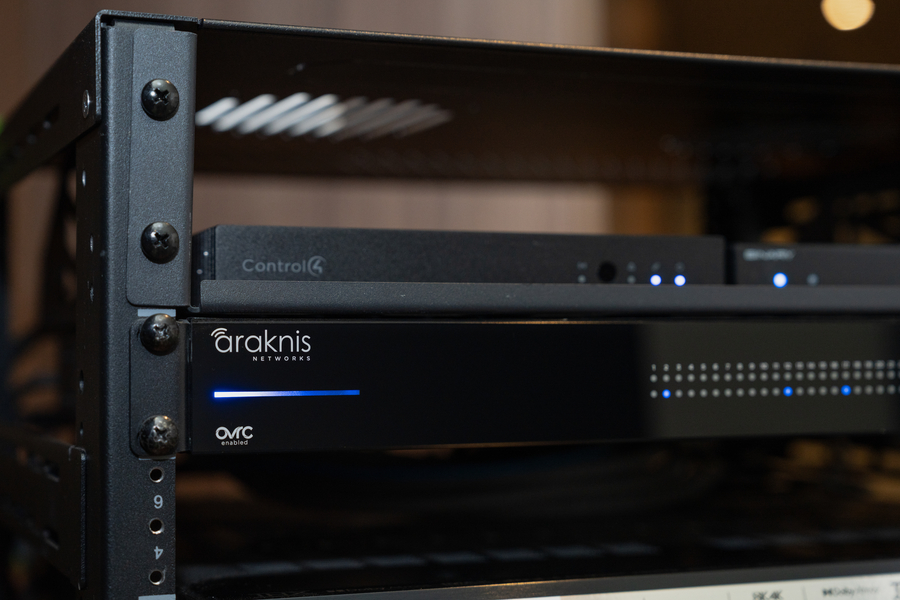
An important component of any smart home design is the central rack. Every cable gets run and terminated at this central location based on pre-established documentation for cable paths and rack layouts. Cables are neatly organized and labeled to make it easier to deliver future upgrades and maintenance. These racks typically live in dedicated AC closets that include the necessary ventilation to protect all your AV, networking, and security components.
Extended whole-home networking coverage
That wiring foundation is the first step to upgrading your network—which is vital to coordinating all your other smart home devices for lighting, shading, climate, and more. Aside from that proper topology to handle the load, you need devices with the right bandwidth. Beyond a standard router, our typical networking installations include managed switches, RF communication for control devices, and VLAN implementation to protect prioritized data.
Protecting your network from third parties
There’s common fears that more connected devices mean greater risk to their home. Cybersecurity is a real concern and in recent years, just as vital as physical security. VLANs are the first step to protecting your signal. We deploy separate VLANs for vulnerable IOT devices like cameras. We built in guest access, strong passwords, and enterprise-grade equipment from trusted vendors.
Proactive maintenance and security after install
After installation, we offer ongoing support for our clients. One big component is a firmware patching policy. Through remote monitoring, we know when software updates are available and install them automatically to help you implement any new security measures. We’ll be able to isolate any off-line devices and reboot them to resolve issues before you notice them.
We’re proud to partner with top manufacturers in AV, lighting, and control, but success doesn’t come down to a single product. It’s a philosophy of future-proof wiring, centralized control, and excessive documentation. We’re here to design a better lifestyle, not install a few devices and call it a day. To learn more about our technology installations, call us or fill out our contact form.