Why Great Home Automation Is Never Noticed
A design brief on how to give clients technology that blends into their lifestyle
Home automation shouldn’t mean technology overwhelms your design. But, too often, that’s what interior designers have to deal with. A visible equipment rack sitting in a closet that was supposed to hold linens. A keypad that clashes with hand-selected hardware finishes. Speaker grilles fighting the ceiling plan instead of disappearing into it.
Many architects, designers, and builders working on high-end projects have seen details like this undercut months of careful planning. And they’re the ones stuck fielding questions from the client when the final project doesn’t look or feel the way they expected.
Luxury automation should do the opposite. It should support your design intent so completely that a homeowner never has a reason to think about the system at all. That starts with treating technology as part of the architecture, not an add-on bolted in after the drywall goes up.
Designing Around the Architecture, Not Around the Gear
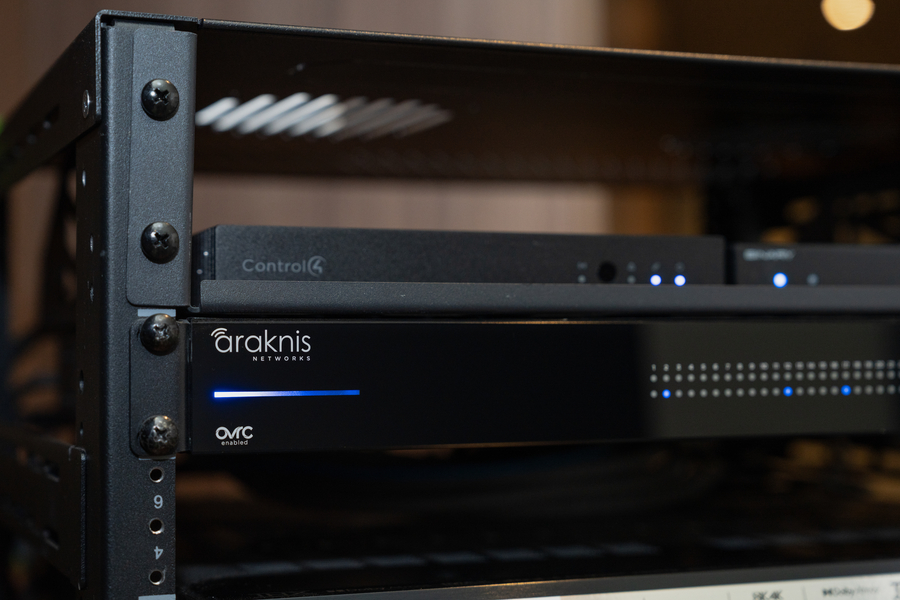
The best automation projects have technicians at the design table. Bringing us in early means equipment racks land in mechanical rooms instead of coat closets, low-voltage runs get mapped before insulation goes in, and your décor is protected from day one.
Too many integrators hand over a hardware list and expect a design to bend around it. We do the opposite. We work out wiring paths, speaker locations, and keypad placement on paper against your drawings and in coordination with your general contractor. Nothing shows up as a surprise punch-list item at final walkthrough, and the finished space reads exactly as you drew it up, not as a technician improvised it on-site.
Audio and Lighting Disappear Into the Finishes
Hidden technology is a requirement in most luxury installs. In-wall and in-ceiling speakers with paint-matched grilles provide high-performance sound without a single visible drive. Low-voltage lighting control offers scenes in custom Lutron or Control4 keypads to replace a clutter of switches on the wall.
The goal is to get the same performance without the visual cost often associated with it. A great room shifts from bright morning light to a warm evening scene and fills with music for a dinner party, without a guest ever pointing at a speaker or panel. To them, it feels like magic.
The Technology Works Without Demanding Attention
Good automation logic removes decisions instead of adding them. Lutron motorized shades can track the sun's angle and close on their own in the afternoon; lighting scenes automatically adjust color temperature based on the sun’s movement; and the security system arms itself on a set schedule. All of these small tasks are suddenly off your client’s plate.
Clients never have to open an app, though the option is there for anyone who wants it. That's the real measure of a well-integrated home: not how much technology is installed, but how little of it the people living there ever have to manage. It’s the same with the build itself; coordination happens quietly in the background, so it never lands on your desk as a problem to solve.
Invisible automation is the outcome of a technology partner who gets involved before construction starts and treats your architecture as the priority. If you're planning a project where the systems need to disappear rather than compete with the design, loop our team in early.
Contact us to talk through an upcoming build or renovation before the walls close in, so wiring paths and equipment locations are settled before it's too late.